Project 6
Effect of Non-Linear Rheology on Stress Measurements from Borehole Breakouts
Analyzing wellbore failures (i.e. breakouts and drilling-induced tensile fractures (DITF)) remains to be one of the more accessible and robust ways to assess the in-situ state of stress in the subsurface. While the methodology has been established and used widely, observations suggest that its strong underlying assumption of linear-elastic rock behavior is frequently violated, posing serious questions about its accuracy in constraining in-situ stress magnitudes.
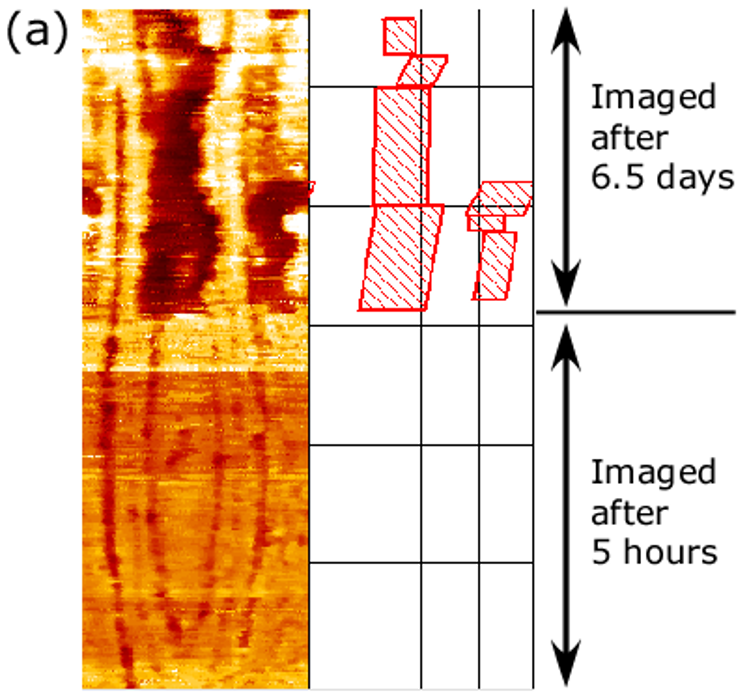
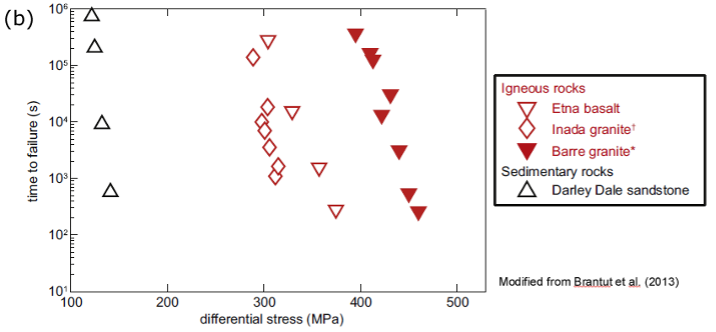
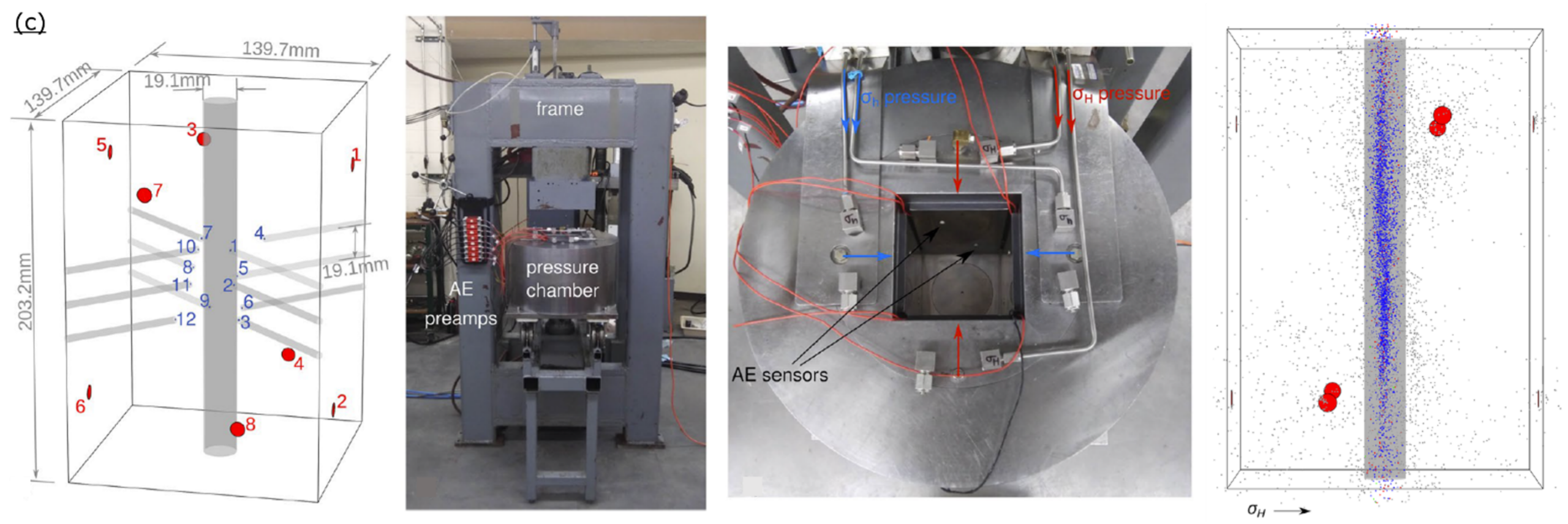
Figure (a) shows an example breakout image showing how its occurrence dramatically changes simply due to time of exposure between drilling and imaging. Especially in sedimentary rocks, breakouts are known to grow over time, which is a result of time-dependent rock failure (e.g. brittle-creep). In such case, the relation between in-situ stress and breakout (width) growth can only be established by characterizing the time-dependent strength of the formation (Figure b). We will conduct laboratory borehole experiments in our true triaxial apparatus to observe and characterize the stress- and time-dependent development of breakouts (Figure c). Optical and acoustic imaging will track the progression of brittle failure over time and failure modes (i.e. focal mechanisms).
Results will be compared with time-dependent strength measured on the same rock through time-to-failure experiments conducted in conventional triaxial apparatuses. FEM numerical modeling with appropriate plastic constitutive laws will be conducted to confirm the relationship between observed breakout development and laboratory measured rock strengths. By exploring variability with rock type, we will highlight conditions requiring modified breakout analyses and strategies for implementing non-linear effects.