
Project 4
The Stress Memory
How Load Path Dependence Governs Mechanical Properties and Damage
The stress and load path dependencies of elastic properties and their evolution under varying damage states are of critical interest to a multitude of communities, such as geophysicists understanding rock properties for subsurface engineering, as well as both civil and geological engineers interested in fundamental damage mechanics of materials.
In this project, we utilize laboratory experiments on various sedimentary and geothermal-related materials (example above shows a Dakota Mahogany granite) to understand the dependence of stress path, orientation, and magnitude on static and dynamic properties, as well as dynamic evolution under varying states of damage. Localized strain and ultrasonic velocity, axial and radially aligned with respect to the sample, are recorded along four distinct load paths with varying ratios of mean and differential stress. Controlling stresses and load paths are determined for static and dynamic properties, such as increasing differential stress for static Young’s modulus and increasing mean stress for undamaged axial dynamic Young’s modulus. A model is constructed to predict phase velocity and orientation/polarization as a function of stress and load path.
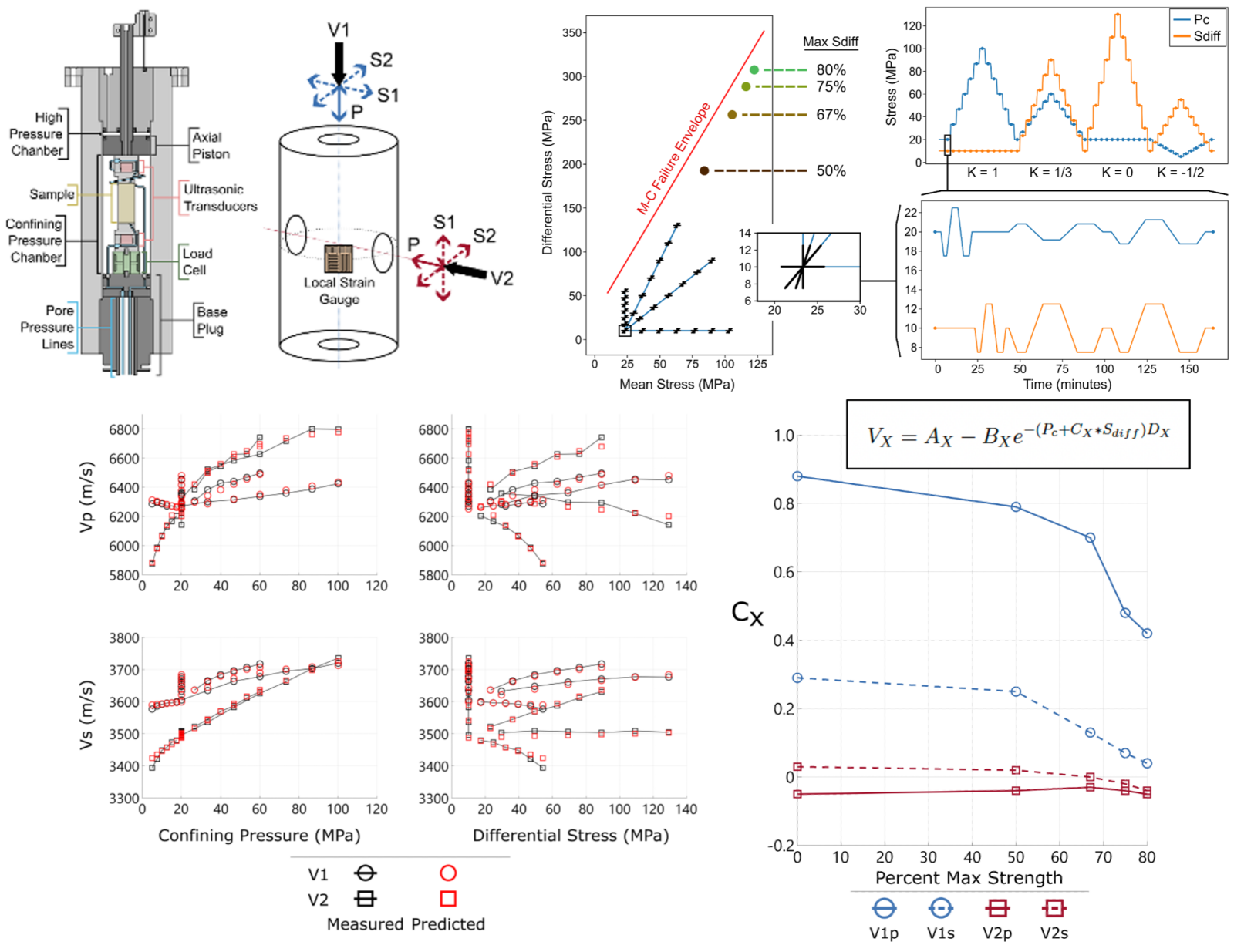
The effect of damage within the material is analyzed by subjecting the sample to increasing stresses along a single load path, after which the multipath testing is repeated. Ultrasonic velocity and thus dynamic moduli become less sensitive to increases in differential stress for wave propagation parallel with the maximum principal stress. This shows that the degradation of physical properties brought about by microcracking overcomes the positive contributions of consolidation with increasing stress. The results provide a way to anticipate changes in elastic response and subsurface acoustic velocity brought about by increased damage, as well as lend insight into the distribution of microcracks and their orientations within a damaged material. The stress and load path dependence of elastic properties, as well as the dependence of stress and load path on damage properties provides a framework for predicting physical properties from static and dynamic elastic stiffnesses to matrix permeability.