
Project 3
Seismic Network Theory
Predicting Field Attributes by Mapping Micro-Seismic Graphic Connections
Predicting attributes of seismic events (nano- to micro-seismic events), such as magnitude and focal mechanisms, at field and laboratory scales requires understanding each event’s role within the context of deformation. Simple predictive models relying on basic features like event time and location overlook the environmental information, which is beneficial for accurate predictions, and machine learning models built solely on these features fall short.
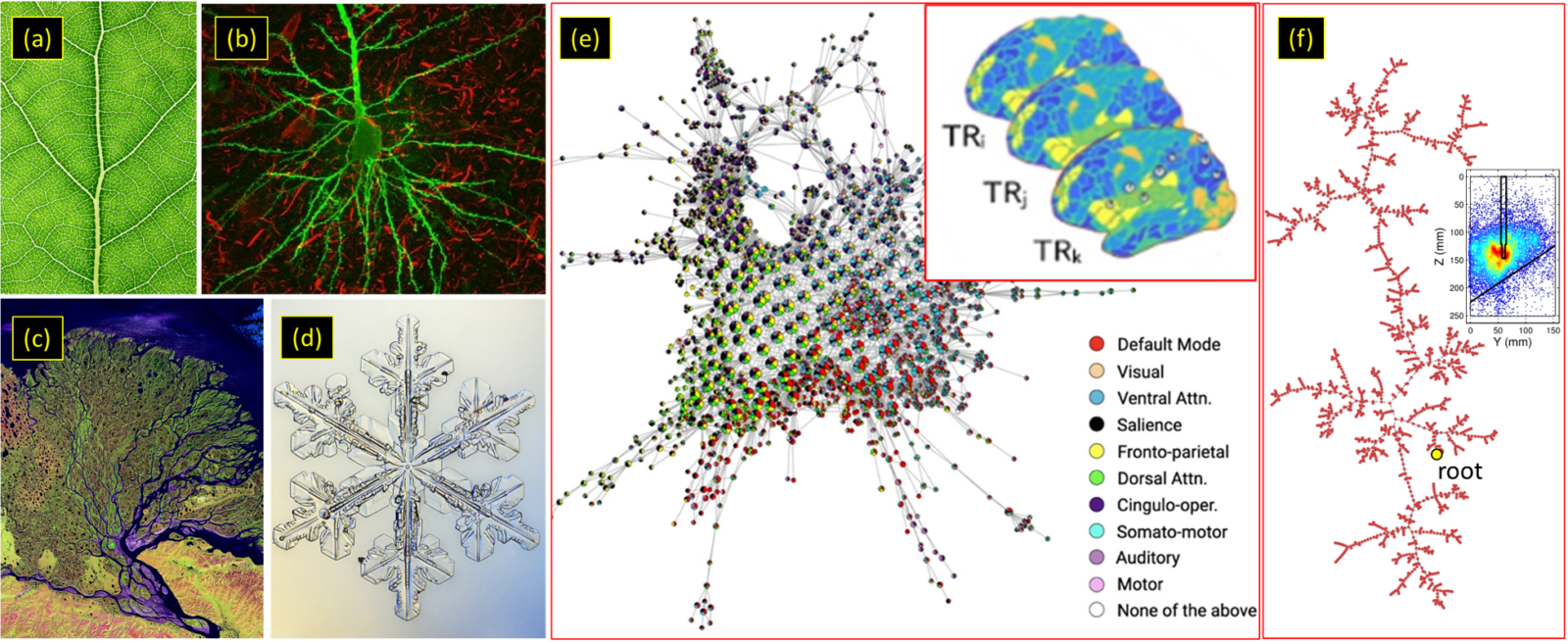
The self-organized nature of rock fracture and the power-law distribution of fracture scale have been observed for decades. The power-law distribution of fractures has many natural analogues, where dendritic patterns can be observed with the naked eye (lowest energy flow patterns in leaves, e.g., (a), from space (lowest resistance flow morphology observed in dendritic patterns of a river delta, e.g., (c), or at the nano and micro scales (confocal microscopy pictures of pyramidal neurons or the development of crystal structure within a single snowflake, e.g., (b) and (d). Each of these scale-invariant examples of connected tree structures can be described by the governing features of the system in which they were developed. One can capture these patterns via graphic analyses, and the graph structures are inherently tied to physical meaning. Conversely, graphic structures can be captured and viewed without the a priori knowledge of the underlying physics. An excellent example of this can be visualized through the lens of brain research and functional magnetic resonance imaging (fMRI) to understand brain activity (e), where brain activity is imaged throughout individual moments in time and a graphic network is constructed for each moment.
These natural observations, coupled with (1) the understanding of stress within rock materials, and (2) the ability to monitor and measure nano- and micro-seismicity, provide a framework for using event catalogs to identify the state of stress and the fundamental connection between event nodes. From here, the next step is to construct graphic structures via spatio-temporal relationships between events (triggering-triggered network) and analyze the graphic network for information regarding node (event) scale and graph (field) scale attribute predictions.
This work addresses these limitations by incorporating organizational information inherent in nano- or micro-seismic catalogs. Adding topological features enables event analysis in relation to others in the catalog–without requiring additional data or waveform information. Beyond basic location coordinates and time, we extract topological attributes such as node degree, clustering coefficient, depth, and centrality from the dataset’s graph structure (nano-seismic graphic structure of triggering-triggered pairs seen in (f). These features help the model to exploit inter-event relationships, providing a more detailed understanding of the catalog’s organization.
Our recent findings show that the addition of topological information significantly improves the prediction accuracy of both node- and graph-level attributes. When deep learning models, particularly graph neural networks (GNNs), are applied, they preserve and analyze the entire graph structure, predicting individual event magnitudes or focal mechanisms with higher accuracy. These models consider each event’s features, along with those of neighboring events, capturing clustering in magnitude or focal mechanisms across triggering-triggered event pairs. This multiscale approach allows GNNs to detect and model complex dataset relationships.
Our results demonstrate the importance of graph structure in seismic catalogs for enhancing predictive performance over other conventional models. Integrating topological features helps improve predictions of energy release events, with significant implications for understanding deformation processes at field and lab scales.