
Project 2
Revealing the Network
Mapping Fracture Geometry Evolution Through Remote Sensing
Laboratory-scale investigations of rock properties have long been instrumental in predicting reservoir-scale behavior. Modern nondestructive evaluation techniques for evaluating rock behavior, such as acoustic emissions and fiber optic sensing, offer extensive data for researchers examining rock properties as well as the multiscale nature of fracture growth and interaction.
Large block samples are particularly well-suited for laboratory studies of complex fracture interactions in reservoir engineering due to their ability to model hydraulic fracture processes. This study employs a polyaxial load frame to simulate in-situ stress conditions on 30x30x45 cm³ samples. Single, doublet, and multiwell configurations are used here to understand the growth of hydraulic fractures within complex stress and geometric environments. The integration of acoustic emission and distributed fiber optic sensing allows for the quantitative inversion of fracture geometries as a function of space and time, such that perturbations like child/parent well interactions can be assessed in terms of reservoir access. The large polyaxial apparatus also allows for the investigation of the fluid flow in complex, and coupled thermo-mechanical-hydro-chemical controlled fracture systems. Evaluation of flow channeling and fracture efficiency is also possible via multiphysics measurements of mechanics, thermal properties, hydraulic tomography, and chemical tracer fate and transport.
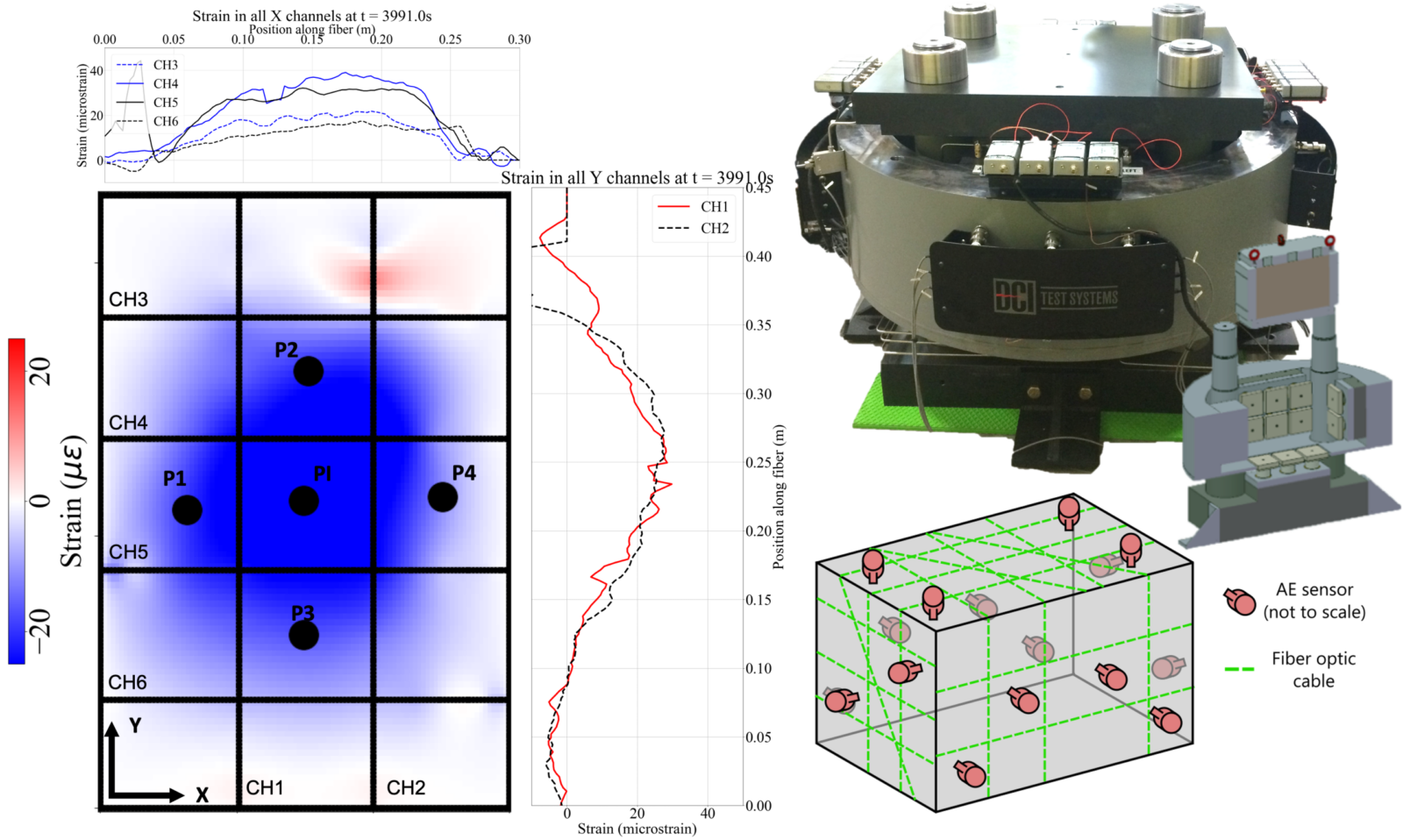
The figure above shows a complex system of wellbores interacting to generate a caged fracture system as evidenced by distributed fiber optic sensing at the surface. By integrating surficial strain measurements from fiber optics and acoustic emission location data, fracture geometry can be identified as a function of location and time such that relationships between reservoir access can be maximized while geohazards, such as induced seismicity, can be mitigated.