
Project 1
Decoding Rock Properties
Quantitative Mechanical & Poroelastic Prediction via Fiber Optic Sensing
Currently, there is a knowledge gap regarding the quantitative determination of mechanical properties in wellbores deep within the subsurface (oil/gas, geothermal, CCS). Core material is rarely extracted due to cost, meaning only field geophysical techniques are available to estimate the mechanical and poroelastic properties of layered formations. Mechanical (e.g., elastic stiffnesses) and poroelastic (e.g., grain stiffnesses and poroelastic coefficients) properties and in situ stress of the subsurface are the main controls of geological engineering interventions, such as drilling, fracturing, and resource production. Therefore, this research aims to develop and test methodologies to predict physical properties as well as their spatio-temporal evolution via remote sensing of distributed fiber optic cables.
To achieve such a goal, distributed fiber optic sensing is leveraged to understand the strains associated with reservoir perturbations. The majority of distributed fiber optic sensing in industry focuses on one of three areas:
- distributed temperature sensing (DTS) for various applications such as determining perforated zones actively accepting injected fluid,
- distributed acoustic sensing (DAS) for microseismicity monitoring and identification,
- distributed acoustic and/or strain sensing (low-frequency DAS or DSS) for understanding fracture geometry and/or fracture hit identification.
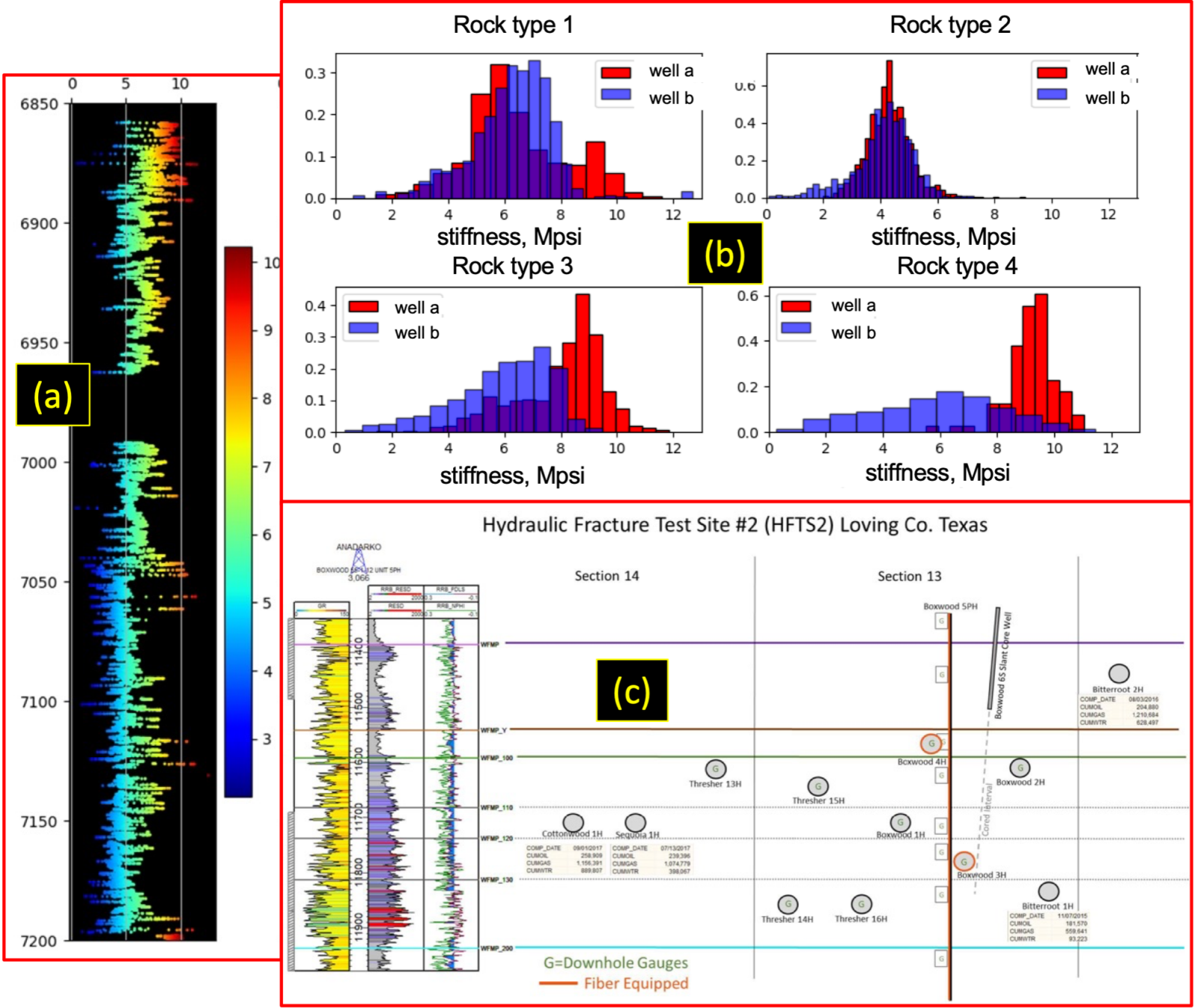
These are oversimplifications of what is being done in industry, but in general terms, low-frequency strains (low-frequency DAS or DSS) has mainly been used to answer questions on fracture geometry and location. Here, we are using the measurements of strain as well as perturbations of the reservoir to understand and determine the mechanical properties and fine-scale variability of the formation–allowing a continuous picture of physical property evolution throughout the entire life of the reservoir during production, infill drilling, refracturing, and eventual abandonment. We will use the public Hydraulic Fracture Test Site #2 (HFTS2) data as it is an excellent representation of fine-scale variability, fracturing, and fiber data. The figure above shows both the existence of fine-scale mechanical variability (a) and the fundamental differences in mechanical properties of the same rock types observed across wells (b). Our goal is to use the low-frequency strains observed within the field to understand and quantitatively determine mechanical properties, variability, and their evolution.