Project 7
Long-term Triaxial Test
Constraining Creep and Mechanical/Chemical Healing
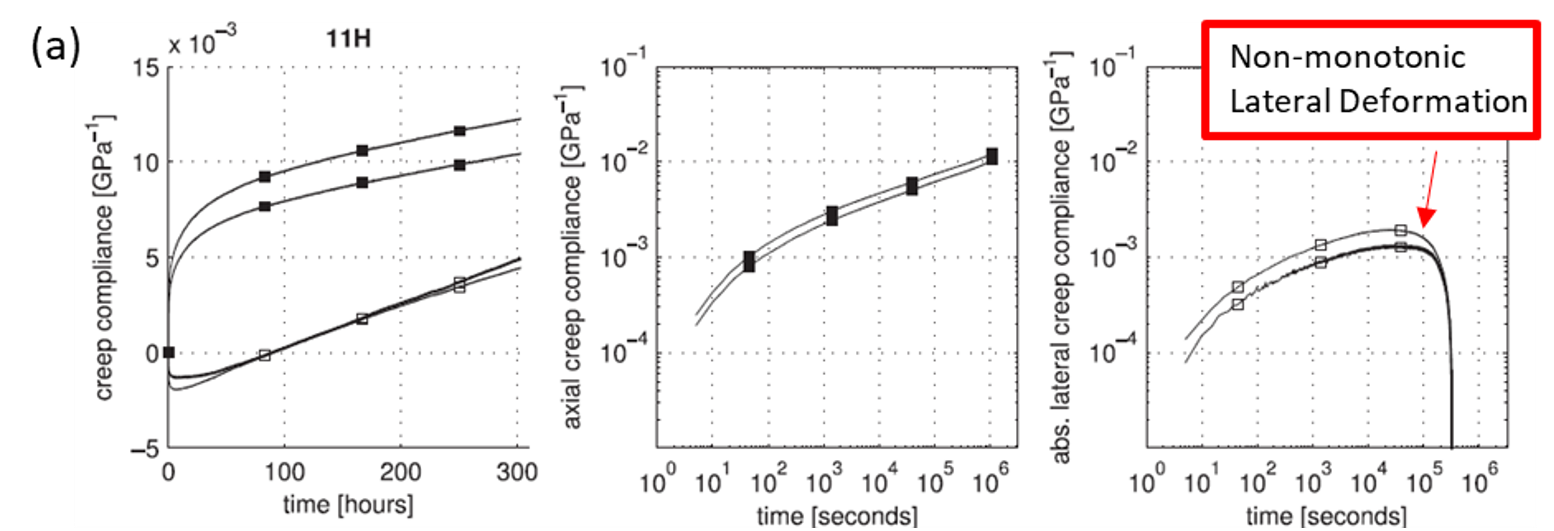
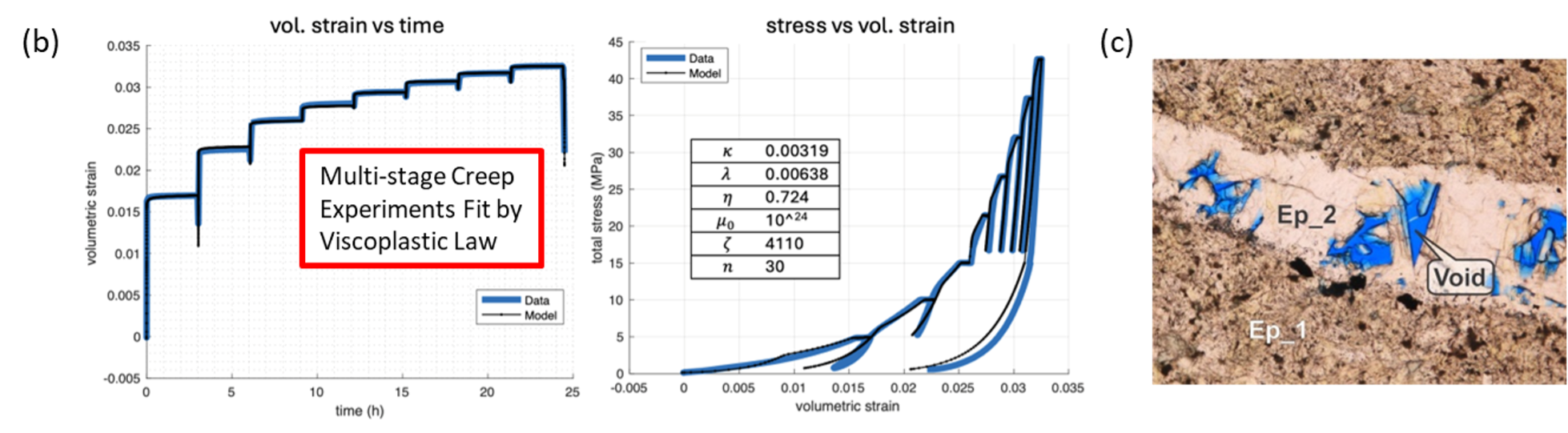
Time-dependent (viscous) rock deformation is an under-explored but important rock behavior for understanding the damage-healing and stress-relaxation that occurs in clay-rich and damaged rocks. The viscous-relaxation model (Sone & Zoback, 2014) introduced first-order insights into how viscous creep relates to reservoir stress heterogeneity but is far from complete due to the simple linear viscoelastic equations used in the calculation. The volumetric behavior is often complicated exhibiting non-monotonic behavior over time (Fig a). The time-dependent behavior of rocks is more precisely characterized as elastic-visco-plastic, which requires further rheological definitions than a linear viscoelastic model (Figure b). Moreover, rock behavior beyond few weeks is little known due to the lack of data.
Refining our rheological models not only improves our stress analyses but also explains the damage-healing behavior which leads to temporal change in rock permeability. Understanding the relation between viscous deformation, healing (velocity change), and permeability change through long-term experiments provides basis for monitoring reservoir performance through geophysical methods. The long-term evolution of rock permeability is also influenced by chemistry, especially in hydrothermal settings. Evidence of hydrothermal reactions carrying away (dissolution) and/or leaving material (precipitations) in permeable paths are abundant (Figure c), but the time-scale of such transient phenomenon is poorly understood.
We are designing a decadal-scale testing capability that will allow us to collect long-term rock mechanical data at affordable costs. The system consists of mass-produceable triaxial pressure vessels, 2 syringe pumps, and a custom-built control system that will allow simultaneous experiments running over multiple years. Temperature is precisely controlled (<0.01 degrees) to minimize thermoelastic noise. The facility will provide much needed long-term data to answer key questions to refine our rheological models.